

Five Claims About Catholicism that Don't Survive the Historical Record
A dishonest chart misrepresenting Catholic history also falls flat in its doctrinal claims. Here's the con job, and a response to five of its claims.
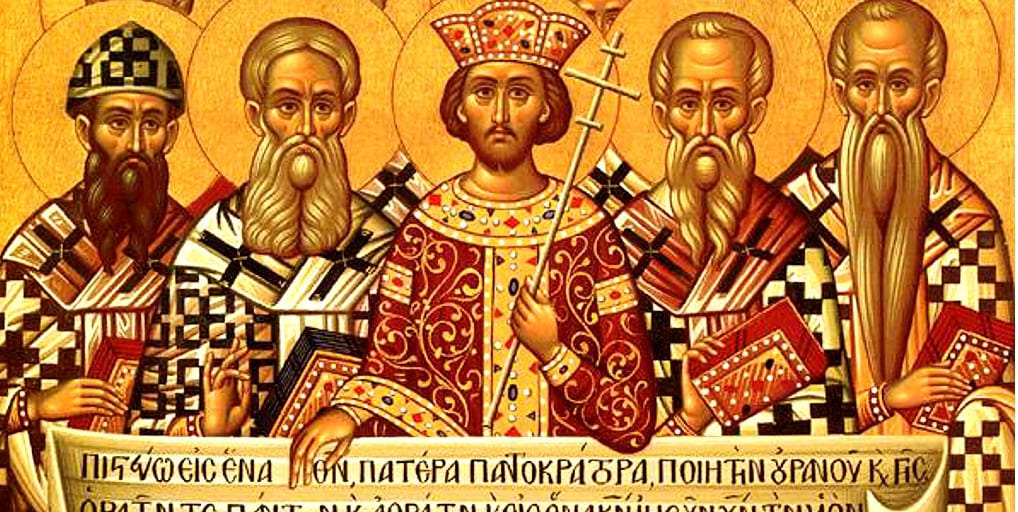
A chart has been circulating online that presents itself as a straightforward historical comparison of what the early Church believed to “Roman” innovations of the Middle Ages, and suggests that the Reformation restored authentic Christianity. But the chart tells lies by its existence, before it even begins making a single claim.
This lengthy article can be broken down into two parts. First I’ll address why the spreadsheet is a con job that immediately sets false parameters. In the second half I’ll address five of the claims found in it
(article continues below the chart)
For more articles like this, subscribe to The Forge
Part One: The Con Job
Before we get to what the chart says, we should talk about where it starts. The baseline for “the early church” is 200 AD. Not 33 AD. Not 100 AD. Not even 150 AD. Two hundred. That’s not a neutral choice. The first century of Christian history — the apostolic period, the letters of Paul, the writings of the men who knew the apostles personally — is quietly left off the chart. So is most of the second century. And that omission does enormous work in favor of the chart’s conclusion, because the witnesses closest to Christ and the apostles are precisely the ones who would most damage it.
Ignatius of Antioch, who, tradition holds likely knew the Apostle John, wrote around 107 AD. He described the Eucharist as the flesh of Christ in terms so direct that no Protestant commentary has ever fully explained them away.
Clement of Rome, writing in the late first century, intervened in the affairs of the church in Corinth with an authority that looks like something more than just a friendly suggestion from one congregation to another. These voices don’t get. representation anywhere on the chart. They predate the 200 AD cutoff, so they simply don’t exist within the chart’s frame of reference.
This is the chart’s central illusion. By starting at 200 AD, it cuts off the era where the roots of these doctrines are most visible, and then it marks them absent. It’s a false parameter. It’s cheating. It’s making you look up at the sky when the action is happening on the ground. It’s a magician working an illusion, or a con man plying his craft. The blank slate isn’t historical, it’s manufactured.
The ‘Missing’ Link
There’s a second problem with the chart’s logic. It treats the absence of a formally defined doctrine as evidence that the doctrine didn’t exist at all. And unless a person referencing this chart has some knowledge of church history and an understanding of how the church works, the tactic would likely not even be flagged.
Doctrine lives in the life of the Church long before it gets formally defined (preached, prayed, celebrated in the liturgy, handed down from one generation to the next). When a council eventually defines it, the council isn't inventing it, it’s exercising the Church's authority to take what has always been believed and make it official, locking it down in precise, binding language.
Keep in mind also that the early Church existed on the teaching of the Apostles, handed down from Sacred Tradition. Some reading this may be wondering why there weren’t automatically official declarations of these beliefs if the church already held them. The answer to that is that the church was still new, and church mechanisms that seem obvious to us today either did not exist yet in the early church or they hadn’t been fully developed yet in the early church. A mechanism for taking something from sacred tradition and making it a “official doctrine” was developed organically. It didn’t already exist because it wasn’t necessary in the early history of the church.
The trigger for a council and official declaration of a teaching/doctrine is usually controversy in the church. The controversy is the occasion, not the source. The doctrine as a belief and practice is always older than the official definition at a council. So t he fact that a council hadn't formally defined transubstantiation by 200 AD doesn't mean Christians in 200 AD didn't believe the Eucharist was the body and blood of Christ, or that the Church wasn't teaching and preaching it. It means nobody had yet forced the official definition.
With that in mind, let's look at the five most egregious claims in the chart.
Part Two: The Claims
These are the most off-the-wall claims in the chart, and they warrant the most attention.
Transubstantiation
The chart has transubstantiation as a “No” for the early church, probably on the grounds that the term itself wasn’t in use. It’s true you’re not going to find the word “transubstantiation” in early church writings, but that’s not because the church didn’t believe it. Transubstantiation—the real presence of Jesus Christ in the Holy Eucharist after the consecration at Mass—has always been Christian belief because it was apostolic teaching.
The word transubstantiation was formally defined at the Fourth Lateran Council in 1215. Just because the word only seems to pop up there, it doesn’t mean it wasn’t already Christian belief. And we can say that very confidently because the evidence isn’t hard to find in early church sources.
Ignatius of Antioch, writing around 107 AD — close enough to the apostles that he was a disciple of John himself — described those who “abstain from the Eucharist and from prayer, because they confess not the Eucharist to be the flesh of our Saviour Jesus Christ, which suffered for our sins, and which the Father, of His goodness, raised up again.” He wasn’t describing a symbol. He was defending a reality against people who denied it. That’s 107 AD — well before the 200 AD cutoff the chart leans on, and that’s probably on purpose.
Justin Martyr, writing around 155 AD, was just as direct: “For not as common bread and common drink do we receive these; but in like manner as Jesus Christ our Saviour, having been made flesh by the Word of God, had both flesh and blood for our salvation, so likewise have we been taught that the food which is blessed by the prayer of His word, and from which our blood and flesh by transmutation are nourished, is the flesh and blood of that Jesus who was made flesh.”
The formal term for it came later. The doctrine it names didn’t.
Praying to Saints
This one is listed as a “No” for the early church, but the archaeological evidence alone is enough to challenge that. The catacombs were burial places of early Roman Christians, some dating to the second and third centuries. They contain inscriptions asking the martyrs to intercede for the living. One well-known third-century example from the catacombs at San Sebastiano reads “Paule et Petre, petite pro Victore” — “Paul and Peter, pray for Victor.” These were not medieval innovations. They are scratched into stone from an era when the church was still being fed to lions.


NOTE: Protestants (or others) will object that these inscriptions reflect Roman pagans layering pagan customs over their new Christianity. But the graffiti at the catacombs aren't only in Latin. They include Greek and Aramaic or Syriac, scratched by pilgrims from the Christian East who carried no Roman pagan baggage. The same practice of asking the martyrs to intercede shows up in North Africa, Asia Minor, and Syria — regions with entirely different pagan backgrounds. The syncretism theory only works if you isolate Rome. Once you account for the rest of the early Christian world, it falls apart. The only thing these pilgrims and cultures have in common is the Christian faith.
The theology behind asking saints to intercede follows directly from beliefs the chart doesn’t contest: that the dead in Christ are alive, that prayer is simply asking, and that asking a fellow Christian to pray for you is hardly remarkable at all. The only question is whether death ends that fellowship. Clearly the early church didn’t think it did.
Confession to Priests
The chart treats formal sacramental confession as a Catholic novelty. What the early church actually shows is a robust practice of public and private sacramental reconciliation, with the bishop or priest playing a central role in restoring the penitent to communion.
In the late second century, Tertullian describes a formal practice of penance in On Repentance. The penitent confessed serious sin, performed acts of sorrow, and was reconciled to the church through its presbyters and bishop. Later, in his Montanist period, in On Modesty (De Pudicitia), he attacked the bishop of Rome for extending reconciliation to adulterers. And that objection actually strengthens the point: Tertullian wasn’t denying the bishop had authority to reconcile. That was uncontested. In fact, it was obvious. What upset him was that he thought the bishop was using that authority too generously. The authority itself was assumed on both sides of that dispute.
The Didascalia Apostolorum, a third-century church manual from Syria (not to be confused with the earlier Didache), gives bishops explicit authority over reconciling sinners, comparing them to physicians of souls who can bind and loose. Origen, Cyprian, and others don’t debate whether priestly authority for reconciliation exists but how severe sins should be handled and how often reconciliation can be extended. The argument in the early church was never “should priests be involved in reconciliation?” It was “how and when?”
What the chart calls an innovation is really a development in how a consistent practice was structured and understood over time. Development continued to occur over time. Confession today looks different from what it did for Tertullian, but the sacramental essence is the same.
4. Seven Sacraments
Marking the seven sacraments as absent from the early church is technically accurate in this narrow sense: nobody sat down and wrote “there are exactly seven” until the medieval period. But this proves far less than the chart implies.
The sacramental acts themselves — baptism, Eucharist, anointing of the sick, reconciliation, confirmation, ordination, marriage — are all present in the New Testament and in early Christian practice. The work of defining the number was a matter of clarifying what had always been done, not inventing new rituals. Protestants didn’t subtract from a list of seven because they had a better idea. They rejected the sacramental framework itself. Part of the culture of Protestantism, particularly during and immediately following the Reformation, was to distinguish Protestantism from its Catholic roots by modifying almost anything they could. This allowed Protestantism to be “his own man” (like a teenager) and provided material to attack the “pagan Catholic Church,” artificially boosting its own authority.
It’s why the Reformers, prompted by the Jewish rabbinic canon that had developed apart from the early church, removed the deuterocanonical books from scriptural authority. It’s why the seven sacraments and the broader sacramental framework were rejected — even while some of those sacraments were quietly retained in modified form. It’s why the Blessed Virgin Mary was taken off of the pedestal, why saints were no longer venerated, and more. Today, their spiritual descendants unsurprisingly look at the Catholic Church and ask, “Why isn’t it Christian? Why isn’t it like us, the real Christians?” Well, the answer is simple: because the Reformers conned them into thinking that way hundreds of years ago.
Let’s look at an example of that reduction of Christianity in the fifth and final point I’ll address from the chart.
The Deuterocanonical Books (”Apocrypha”)
This may be the most historically awkward claim in the entire chart. It asserts that the early church did not officially treat the deuterocanonical books as Scripture. The implication being that Rome added them later, and it was Protestants who recovered the original Bible.
That, my friends, is historical fiction. The Greek Septuagint—the version of the Old Testament used by early Christians, and the version quoted throughout the New Testament—circulated with these books as part of its broader scriptural corpus. Jerome’s Latin Vulgate, completed around 405 AD, included them (even though Jerome himself had reservations, but the Church regarded them as Scripture anyway. Jerome wasn’t forced to translate them, he was commissioned to). Regional councils at Hippo (393 AD) and Carthage (397 and 419 AD) affirmed canons that included them. The Council of Florence reaffirmed the same canon in 1442, a full century before Trent. The books were never absent. They appear throughout Christian history, dating back to the Apostles. That is historical fact.
What actually happened at the Reformation was that Luther removed them — partly on the grounds that they supported Catholic doctrines he wanted to reject (especially prayers for the dead in 2 Maccabees), and partly because he wanted the Protestant Old Testament to match the Hebrew canon used by rabbinic Judaism. That Hebrew canon had been finalized in Jewish circles after the time of Christ, and it excluded books that had long been part of the Greek scriptural tradition the early church received from its Jewish and apostolic roots.
Do you know why those rabbis settled on the canon they did? Here it helps to know the setting. The Temple had been destroyed in 70 AD. Sacrificial worship was over. The priesthood had lost its central function. The Jewish people were scattered, and a religious life that had been anchored to the Temple and a sacrificial system suddenly had to find a new anchor. What survived and reorganized was rabbinic Judaism, built around study, prayer, synagogue, and Torah. Consolidating around a stable, unified scriptural canon was part of that broader project of religious reorganization, and it makes sense in those terms alone.
But all of that was unfolding against another backdrop: the rapid growth of Christianity, particularly among Greek-speaking Gentiles, using the Greek Old Testament. Judaism and Christianity were actively separating from each other in exactly the same decades the rabbinic canon was taking its final shape. And the canon that emerged from that process excluded books the Christians were using. Whatever else was at work, distinguishing Jewish Scripture from the version Christians had inherited was part of the picture. So when protestants say they’re using the real bible, the fact is they are not.
Conclusion
There are five of the claims, and five of the failures. And in each case, the failure isn't accidental, it follows directly from the graphic's original sleight of hand. Show people a chart that starts in the wrong place, hide the assumption holding the whole thing together, and most readers will never think to ask why the clock starts at 200 AD and not a century earlier. That's the con. Now you've seen it. The next time someone slides this graphic or one like it into a conversation as though it settles something, you’ll know exactly what to think of it, and exactly what to say.
Excellent summary and rebuttal
I think it's quite ironic that they cite the vernacular scripture being used in service in 200 AD. Well yeah but the vernacular was Greek and Latin, but then it says "no" during the Reformation, well yeah because it had always been in Greek and Latin. Just too good.