

The Remnant isn't Who You Think it Is
What the Bible, and Marian apparitions reveal about the Faithful Few—and why they're not who you expect.
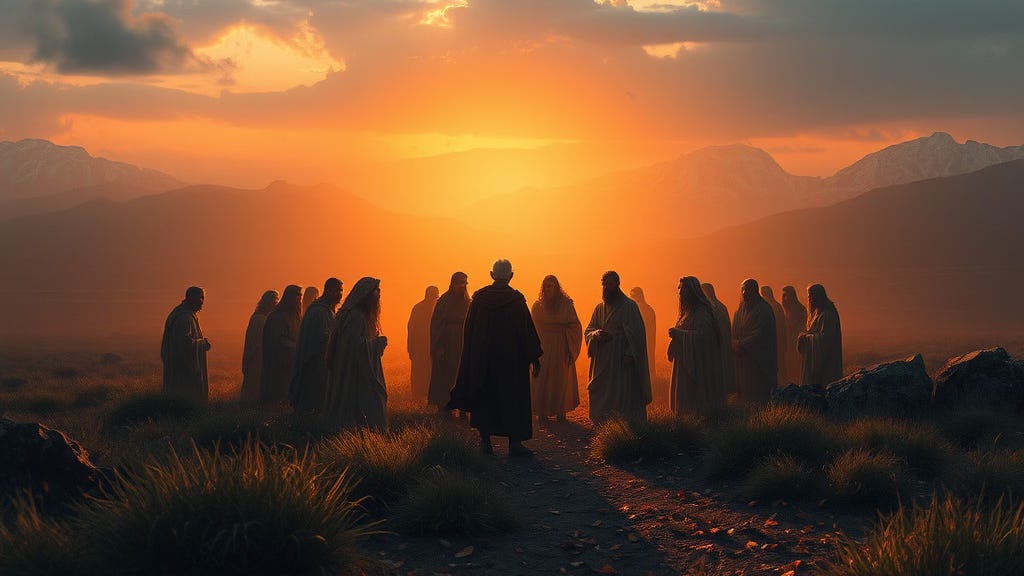
The concept of the remnant is a central theme in both Scripture and some Marian apparitions. It refers to the faithful few who remain true to God in times of trial, not because they are perfect saints but because they endure in truth (Which is what Jesus means when he calls us to “Be perfect as the Father in Heaven is perfect”). This faithful group is often ordinary Catholics—imperfect, yet striving for holiness in their ordinary daily lives.
Old Testament
In the Bible, the remnant is introduced during times of crisis. In the Old Testament, when Israel fell into sin and idolatry, God promised to preserve a faithful remnant.
Prophets like Isaiah and Jeremiah spoke of a purified group who would remain loyal to God’s covenant despite widespread apostasy. In Isaiah 10:20-22, we read,
“In that day the remnant of Israel, and the survivors of the house of Jacob, will no longer rely on him who struck them down but will truly rely on the Lord, the Holy One of Israel. A remnant will return, a remnant of Jacob will return to the Mighty God. Though your people be like the sand by the sea, Israel, only a remnant will return. Destruction has been decreed, overwhelming and righteous.”
That passage emphasizes that the remnant is defined by sincerity of faith, not outward appearances. The faithful few, despite the apostasy around them, would continue to trust and rely on God alone.
New Testament
In the New Testament, St. Paul speaks of this remnant when he writes,
“At the present time there is a remnant, chosen by grace”
-Romans 11:5
The remnant is not about human merit—because they we’d all be in trouble—but about God’s grace and the perseverance of those who remain faithful to Christ’s teachings. Then in Revelation, the faithful remnant is depicted as those who keep the commandments of God and hold to the testimony of Jesus.
“The remnant is not the elite or those who appear most devout”
Marian Apparitions
Marian apparitions reflect the same idea. While the word remnant isn’t explicitly used, The Holy Virgin’s messages often highlight the perseverance of the faithful few. At Fatima, La Salette, and Kibeho, Mary calls for prayer, penance, and conversion—urging a small but faithful group to remain steadfast in holiness, despite the chaos of the world. Her messages emphasize humility and sincerity, aligning with the biblical concept of the remnant.
The remnant is not the elite or those who appear most devout on the surface. It’s the ordinary Catholic—the one who continues to strive for goodness and holiness, even amidst personal, the lures of a worldly life, and who strive for the substance of holiness, not merely the form or appearance of it. In today’s culture, being part of the remnant is already a heavy lift. The world pulls us in so many directions, and Catholics/Christians get pulled and tugged alongside nonbelievers—we are not immune, our temptations are just different. Yet God is pleased by those who persevere in Truth, not by outward appearances.
Are you persevering in Truth? Are you trying hard? That makes you a hero in our time, even if you don’t “feel it”.
If the remnant is real—and I believe it is—it’s made up of those who, in their ordinariness, strive for holiness and remain loyal to Christ, especially when it’s difficult. And that, above all, pleases God.
Consider supporting my work by becoming a paid subscriber.
Not convinced yet? No problem! You can become a paid subscriber and still be a part of the Truth revolution here at The Forge.
Love this post. You're spot on. The Remnant will be the ones striving for holiness, not the ones waving faith like a banner to beat others, but sharing God's love until the End.