

The Argument for Native Language Prayer - Post Show #49
Why the language that formed your soul is the language you should pray in—and why praying in Latin might fall short.
Hi subscribers, and visitors to The Forge! Since launching Firebranded.fm I ordinarily don’t post these Post Show notes to The Forge, I only post episodes here. But today I wanted to share the latest Post Show article, because I think The Forge readership will really enjoy it.
🔥 If you’d like to watch/listen to the episode itself, you can find it at The Forge. Prefer another network/app? The episode page at FireBranded.fm has those alternative links.
On episode 49 of Fire Branded, I promised to share an ontological/anthropological argument for the objective value of praying in your native language. This is not an academic article in the least. It’s just a brief but substantial rundown of the most important points to the argument.
👉 You’ll find a couple of short clips below. They only play in a browser, not an email app
There’s no explicit Catholic doctrine saying “native language is spiritually superior.” There’s none that says praying in Latin is superior or more potent either, but what does exist is a very rich Catholic understanding of the unity of body, intellect, memory, affection, imagination, speech, and language. From that, we begin to see a strong anthropological argument for the value of praying in one’s native language as opposed to praying in Latin.
The cleanest path forward is through an application of the incarnation, habit, and the Thomistic understanding of how humans know, love, and experience reality.
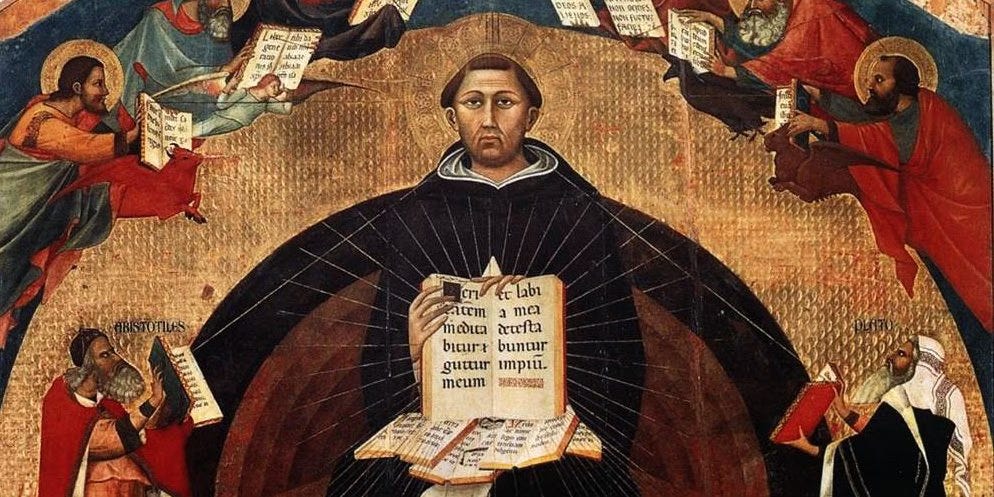
Saint Thomas Aquinas.
Human beings are not pure intellects like angels. We come to know through our senses, imagination, memory, images, sounds, habits, and embodied experience. The intellect works through phantasms — meaning our thinking is tied to lived, sensory, experiential reality.
💡 What's a "Phantasm"?
For Aquinas, Phantasms are the mental images we form from our senses—basically, the pictures in our mind that help us think about the world we experience.
So a person’s native language is not merely a code you learned intellectually. It’s attached to our lived experience, just as the memories attached to, say, a scent is. It’s part of who we are as unique persons, not just what we are (human creatures) Your native language, then, is:
The language in which you first loved,
First feared,
First repented,
First trusted,
First suffered,
First received affection,
First encountered authority,
First encountered mercy.
In other words, your native language is woven into the formation of your emotional and imaginative life. It’s woven into your active being.
That isn’t sentimentality, it’s classical Catholic anthropology. Accordingly, no language could ever replace or replicate the personal experience or expression tied to the language of your formation (your native tongue).
So because man is an embodied soul, language isn’t merely informational. Language becomes bound up with experience, memory, affection, imagination, and habit. It carries who you are. So a person’s mother tongue ordinarily possesses a unique capacity to carry the movements of the heart. And that’s the goal in prayer.
The Incarnation
God didn’t save us through abstract transmission of concepts. The Word became flesh and entered a particular human culture, language, people, and history. Christianity is deeply incarnational. Grace does not bypass human nature; it works through it.
Grace elevates nature; it doesn’t erase it. And one of the deepest elements of human nature is the language through which the soul learned to perceive reality.
Pope John Paul II often about language as carrying culture, memory, identity, and the soul of a people, especially in his writings on nationhood and culture. He saw language as more than utilitarian communication; it transmits a way of seeing reality. Can that transmission happen with Latin? It could, sure. But for non-native speakers, it’s only carrying ideas and maybe identity. It isn’t carrying “the person” (argued above).
(conclusion continues below)
Conclusion
A language learned later in life remains more conceptual and external, while the native tongue is ordinarily tied to the affective and imaginative life of the person. Can Latin ever carry the heart of a non-native speaker? In some rare circumstances I suppose it could. But I believe it’s highly exceptional. I had become very familiar with Latin and very used to praying in Latin. I had a better-than-elementary level understanding of the language, the nuances of some of its words and some of the phrases in prayers. (the difference between “Crying out” and “Clamare” for example). I could rattle them off in Latin as easily and as fluidly as I could in English. When I prayed in Latin, I prayed with a high level of understanding and attention, but it still did not carry my heart the way praying in English does.
“To thee do we cry, poor banished children of Eve” does not communicate the nuances of “Ad te clamamus, exsules filii Evae” Yet still the English phrase carries more of my heart and the expression of my being.
Hey, everybody’s different, and every pray-er is different; I acknowledge that. But let’s be honest, my people, some things are universally true. I think the benefits of praying in your native language is one of those universal truths.
(Okay, so this turned out not to be as quick as I expected. That’s very normal with all things Fire Branded 🤣)
Comment below and share your thoughts and reactions to this. God be with you, guys!
Full Episode:
The Gathering Storm - Ep. #49

‼️ PAID MEMBERS: There’s an extra segment at the bottom of this post, just for you! Thanks for supporting my work!! 🔥
In my experience, prayer is more than reciting words that I understand.
In effective prayer, there is a mental and spiritual environment that is created to encompass the words that may also be spoken or read. It's why some deeply spiritual moments have NO words associated with them.
When you're surrounded with extraordinary nature, you don't need words to say "Gosh, this is beautiful" to become enraptured and uplifted in the moment. The best instances of prayer are like that too.
Words, spoken or read, are part of prayer. Environment, mood, focus, concentration, and intent all may be as important or more so.
Much as the traditional rubrics of the TLM foster a reverent mass, so can Latin prayer help create the environment for effective prayer.