

Pope Leo XIV Says Just War Theory Is “Outdated.” Here’s What He Actually Means.
What the Pope actually said in Magnifica Humanitas — and why "outdated" doesn't mean what the headlines suggest.
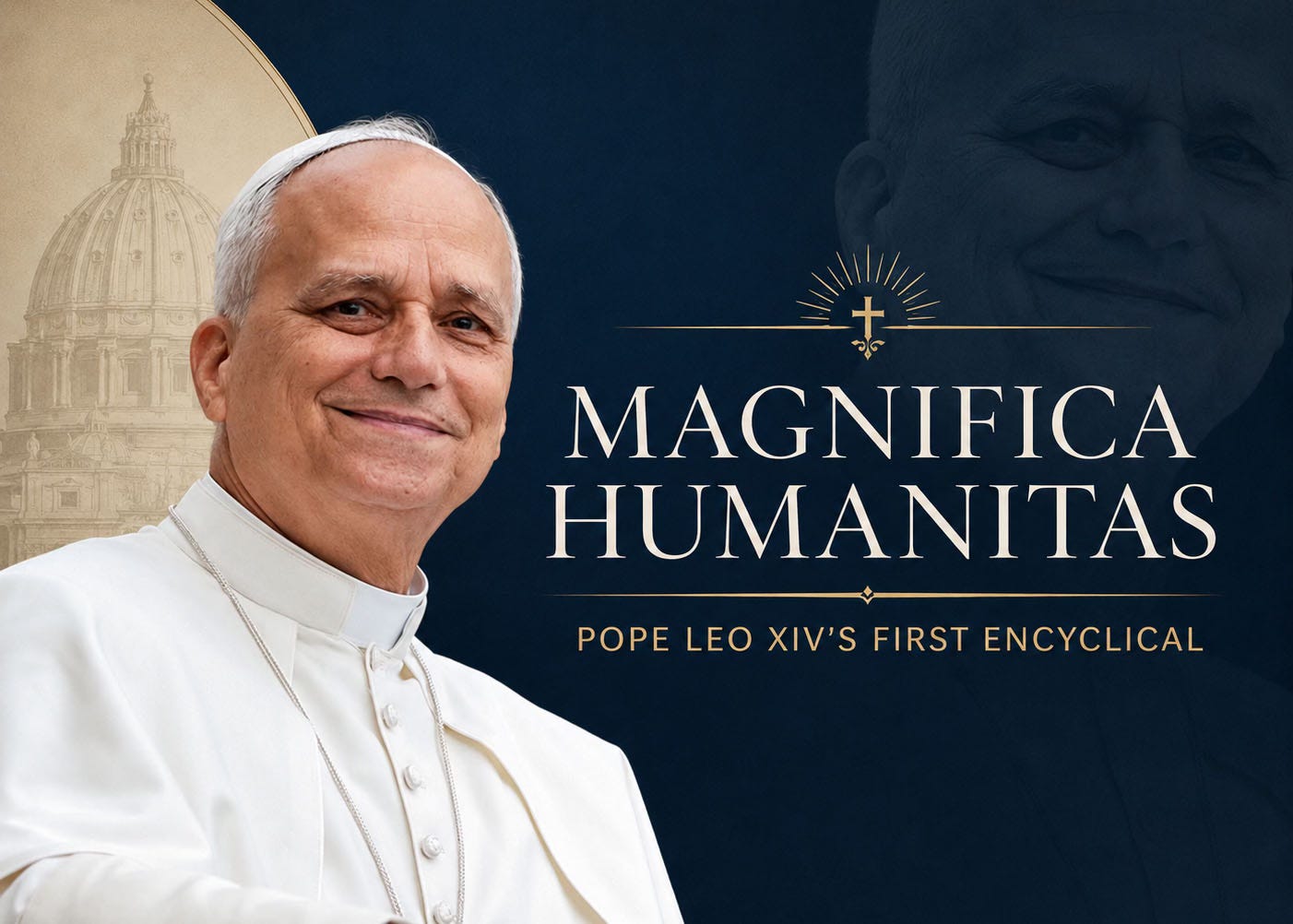
In his first encyclical, Magnifica Humanitas, Pope Leo XIV does something that’s going to get quoted out of context for years. He calls just war theory “outdated.” If you only read the headline, it sounds like the Church just walked away from sixteen centuries of moral reasoning about when force is justified. That’s not actually what happened. Watch for the drama pimps and controversy brokers to frame this as a break from Tradition. But I’ll tell you what the Holy Father is really saying
Chapter 5 of Magnifica Humanitas
The short version: Pope Leo isn’t throwing out the classical Just War philosophy. He even explicitly repeats the right to self-defense. What he’s actually arguing is that the framework has been so routinely abused as a justification machine that it no longer functions as a real moral brake, especially with modern AI and automated weapons making war-waging a much easier (and cheaper) decision. Whether that’s true is a fair thing to debate. But it’s a more careful claim than the headlines suggest, and the chapter deserves a much close reading than a headline, a subtitle, or a social post.
Here’s a walk through the most significant things Leo says, what he means by them, and what has actually changed.
What is just war theory?
Let’s start with a quick grounding in traditional Just War thought. Most people have heard the phrase and have a rough idea of what it is. But the specifics are important for what Leo is doing in his encyclical.
Classical just war theory is a framework that developed through Augustine and Aquinas and was later systematized by thinkers like Francisco de Vitoria and Francisco Suarez. It splits into two parts. The first, jus ad bellum, governs when it is just to go to war at all. Criteria like legitimate authority, just cause, right intention, proportionality, reasonable chance of success, and last resort are wrapped up in jus ad bellum.
The second, jus in bello, governs how a war may justly be fought once it’s underway. Most importantly the principles of discrimination (don’t target civilians) and proportionality (don’t use more force than the objective warrants—something drilled into us when I was in the Marine Corps).
That distinction between getting into a war and how you fight a war is going to matter later, so keep it in your pocket.
“Just war theory is outdated”
This is the line everyone will quote. Here it is in full, from paragraph 192:
“Today, more than ever, without prejudice to the right to self-defense in the strictest sense, it is important to reaffirm that the ‘just war’ theory, which has all too often been used to justify any kind of war, is now outdated.”
Notice what he does and doesn’t say there. He doesn’t say self-defense is off the table. In fact he explicitly protects it “in the strictest sense,” which is the most foundational element of the whole tradition. And his criticism of just war theory isn’t that the criteria are philosophically wrong. It’s that the framework “has all too often been used to justify any kind of war.” That’s a criticism of how the theory has functioned in practice; a permission slip rather than a constraint. In other words “self defense” could be the reason to respond to an imminent threat, one that we predict, or one that we imagine to be possible at some point in the future. That range of considerations isn’t what the “Self Defense” clause in Just War theory is supposed to permit.
But this raises an honest question: Who exactly is actually using just war theory to make war-time decisions? It’s not as though defense ministries keep a theologian in the room running through Aquinas before deciding whether to strike. So who is “doing” what the Holy Father is warning against? In practice, the framework mostly lives in academic theology, in the Church’s commentary on conflicts already underway, and in the language nations reach for after they’ve already decided to act.
But the Holy Father’s point is fair. The theory has too often been a wrapper applied to decisions made on other grounds, not a genuine test that constrained or determined those decisions.
The real argument: war is being normalized
Here’s the part that most coverage missed so far, and it’s the key to reading the whole chapter honestly. The “outdated” line doesn’t stand alone. It’s the conclusion of a broader assessment woven throughout paragraphs 189 to 192—not just a single paragraph or two, which is how I suspect some media personalities will treat it. There’s a much broader picture here.
Leo points out that there used to be a shared conviction in the world and culture that war should be an absolute last resort. In paragraph 189 he describes how, after the World Wars, “peace was made the focus of the international order,” and how “many national constitutions restricted the use of force to extreme and strictly limited circumstances.” That conviction is now eroding.
From paragraph 190:
“we are witnessing a real paradigm shift in public discourse and in decisions regarding rearmament, with a troubling revival of war as an instrument of international politics, while the very ethical principles that had previously limited its use are being eroded.”
He adds a striking observation in paragraph 191, saying that as the last firsthand witnesses to the Holocaust and the World Wars die off, we’re losing the living memory that made war’s horror real. Without that memory, he warns, “political decisions risk being made on the basis of power alone.”
True! Adam and Eve “knew sin” not because they had an intellectual awareness of it, but because they had done it. They now had the experience of it, and that is a very different kind of “knowing”. It’s deeper, more acute. It’s how we know through memory of a lived experience, and it guides our future decisions. When we lose that cultural “memory” because those who remember have died off, we go forward on impulse and emotions rather than a true experiential knowledge or ‘moral memory"‘
All of this builds to the diagnosis in paragraph 192:
“humanity is slipping into a violent culture of power, where peace no longer appears as a responsibility to be taken on, but as a fragile interval between conflicts.”
So when Leo says just war theory is “outdated,” he’s saying it in the context of a culture that he believes has already abandoned the seriousness the theory had presupposed. His argument is essentially: a framework that always depended on good-faith actors applying it in good faith has lost whatever practical force it had, because the culture around it has dismantled the ethical brakes that gave it meaning.
Autonomous weapons make war “too feasible”
This is where AI enters the scene, and it’s the most modern application in the chapter. Paragraph 197 opens the section on weapons and artificial intelligence:
“The Holy See has recently observed that the growing ease with which autonomous weapons systems can be deployed makes war more ‘feasible’ and less subject to human control. This violates the principle that armed force should be used only as a last resort in cases of legitimate self-defense.”
Read by itself, that paragraph asserts a connection it doesn’t fully explain. Why exactly does the ease of deploying autonomous weapons violate the last resort principle? But the chapter does supply the mechanism for understanding it, in the very next paragraph. From 198:
“AI does not remove the intrinsic inhumanity of conflict; indeed it can only bring about conflict more quickly and render it more impersonal, lowering the threshold for resorting to violence.”
The argument is that the difficulty of going to war has always forced prolonged moral considerations, and attempts at alternatives to war. When a leader has to send his own people into danger, the human cost creates hesitation, deliberation, political accountability. Those are the very things that make force a natural and practical last resort rather than an early option. Autonomous weapons remove that cost. No soldiers at risk, no flag-draped coffins, no public reckoning. And when the cost drops, the threshold drops with it.
Let me present it this way: “We’re just sending drones, it isn’t really a war.” In 1943 those drones would have been bombers with crews aboard, and everyone would have understood it as war.
The technology lets a nation conduct what is functionally an act of war while keeping the perception sanitized. Pope Leo’s concern is that this isn’t a one-off, it’s increasingly the norm.
In fairness to the text and to the tradition, I want to also offer this. Autonomous weapons are mostly a jus in bello question—they concern how force is applied once a conflict exists. “Last resort” is a jus ad bellum questionq—it concerns whether to enter conflict at all. Leo’s argument bridges the two by way of that “lowering the threshold” mechanism. But he doesn’t exactly acknowledge he’s crossing that line. The bridge holds, but it’s built more on an understanding how easy force has become than on a tight technical argument.
“No algorithm can make war morally acceptable”
This is the sharpest single line in the chapter. From paragraph 198:
“Yet moral judgment cannot be reduced to calculation, for it involves conscience, personal responsibility and the recognition of the other as a person. Therefore, it is not permissible to entrust lethal or otherwise irreversible decisions to artificial systems. No algorithm can make war morally acceptable.”
The reasoning is solidly within the Catholic understanding of conscience. Moral judgment isn’t computation. It requires a person who can recognize another person, who bears responsibility, who has a conscience that can be examined and held to account. An algorithm has none of that. It can optimize a target list; it cannot recognize a human being as a human being. So the decision to take a life can’t be delegated to it without losing the very thing that makes the decision a moral act at all.
Worth noting: Leo doesn’t say “don’t build ethical AI.” Immediately after this, he allows that we should still try to instill “values and sound judgment into the artificial systems we build.”
And then, Tolkien
In the final stretch of the chapter, Leo argues that the “civilization of love” he wants to build won’t come from one grand gesture but from countless small acts of fidelity. To make the point, he reaches for J.R.R. Tolkien. From paragraph 213:
“It is not our part to master all the tides of the world, but to do what is in us for the succour of those years wherein we are set, uprooting the evil in the fields that we know, so that those who live after may have clean earth to till.”
A papal encyclical quoting The Lord of the Rings will surprise some people, but it really does fit. The line is about responsibility scaled to your actual reach. You don’t have to fix the whole world, you have to tend the field you’ve been given. That’s Leo’s answer to the despair that says the problems are too big and you’re too small to make any difference. He calls that despair “a polite form of resignation, often disguised as realism” — tying it straight back to the false realism he spent the chapter dismantling.
So what actually changed?
Really…nothing. Nothing substantial, anyway. The right to self-defense remains intact. The core principles of the tradition are not only preserved, they’re reasserted. When Pope Leo lays out his criteria for AI in warfare, the protection of civilians—classical jus in bello discrimination—is all right there, restated for new technology. He isn’t discarding the tradition’s substance. In various places he’s applying it.
What has changed is mostly the application and the framing. The Pope is reading the just war tradition through a heavily pastoral and cultural lens rather than a narrowly doctrinal one. His “outdated” claim is really a judgment about the world the theory now operates in. A world where, in his reading, the ethical brakes have been dismantled and the framework has degraded into merely a justification device.
If you want to push back the strongest ground isn’t “he abandoned the tradition,” or “changed teaching” or “discarded Catholic thought” because he didn’t do any of those things. The stronger critique is that some of his sharpest claims are stated with more confidence than the surrounding argument fully supports, and you’d really have to dig elsewhere in Catholic thought to fully build those pillars. The autonomous-weapons-and-last-resort link, for instance, works as a cultural intuition but blurs the line between jus ad bellum and jus in bello without acknowledging it. A claim of this weight, in a document of this authority, could have been built more tightly. The substance and material exist everywhere in Catholic thought—he’s not introducing novelty. I just wish he had built it into the document. The absence of that material doesn’t risk confusing the faithful, except it does leave a lot of room for bad players in Catholic media to maneuver and distort the meaning of document.
Watch for theologians with microphones and cameras, who know this theology better than I do, come out claiming the document is “so confusing” and “doesn’t make any sense”.
Folks, if you enjoyed this please share it and help build up The Forge. The algorithms won’t do it. I rely on word of mouth and sharing of my articles. And drop a “Like” and a comment and le the know what you thought of the article, or your personal thoughts and reactions to the encyclical in general.
you're awesome, I so much appreciate your effort to "clarify" and support the magisterium