

Outrage Journalism and the Sound of Truth
Some Journalism is just a performance that sounds like Truth but makes you dance to
In 1972, Adriano Celentano released Prisencolinensinainciusol, a strange and brilliant song built from nonsense syllables meant to sound like American English. Not seeing much success with his own music, he jokingly bet a friend that he could make a hit if it only sounded like American music. With a some clever production, instrumental and sound engineering, what resulted was a hit.
The song had the rhythm, attitude, and swagger of American pop music, but the words themselves meant nothing. Celantano couldn’t even speak English. When he entered the studio to record the song, every syllable was made up, on the spot as the recording was rolling. Still, he produced a hit. Celentano created the impression of meaning by borrowing the sound and structure of a language without actually speaking it.
Welcome to the wonderful world of deceptive journalism in media—even in some independent Catholic media (Print, or broadcast)
Celentano’s trick worked because form is powerful. A song can suggest meaning through rhythm, tone, repetition, and performance, even when the lyrics are gibberish. The listener feels the shape of a message and starts to supply meaning where none exists.
A lot of modern media works the same way.
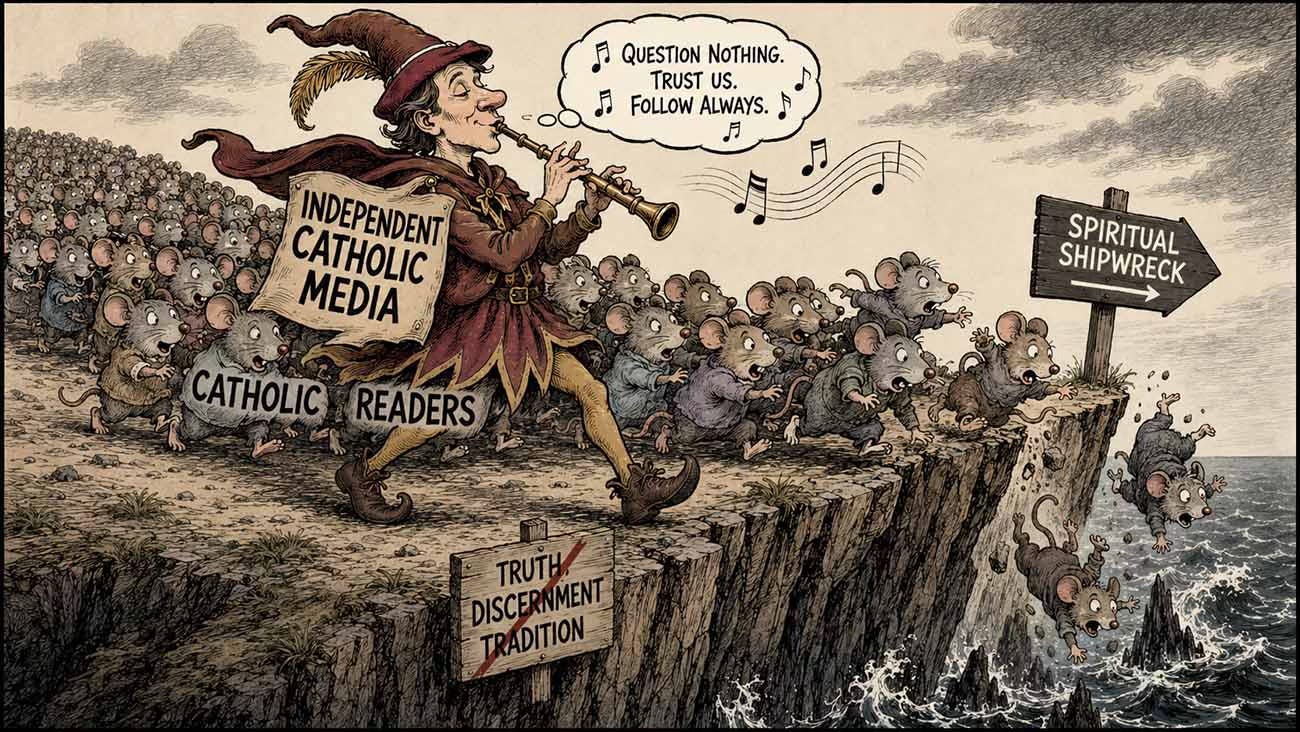
This is obvious in secular outrage journalism, but Catholics should not pretend we are immune to it. Independent Catholic media can do it too. It borrows the external form of serious reporting — headlines, quotes, expert references, anonymous sources, moral urgency, and grave concern — while using those tools to guide the reader toward a conclusion the outlet wanted from the start. It sounds like journalism because the mechanism is familiar. But the purpose is usually not to clarify reality, but instead to shape reaction.
Example and Analysis
Observe, and try not to react emotionally.
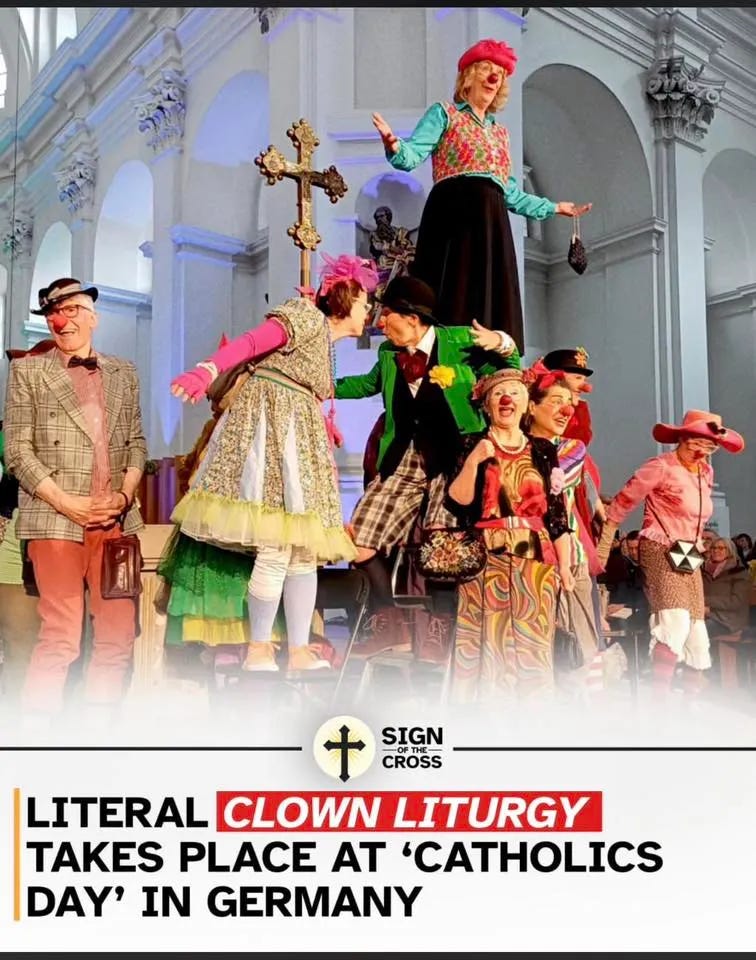
A viral post from the folks behind LifeSite News has readers believing this absurdity in Germany was a clown mass. They signal that by calling it a “Clown liturgy” even though there was nothing liturgical about it at all—and it certainly wasn’t a clown mass.
Other examples include posts that cast a shadow over the Holy Father using emotion-driven keywords and key phrases, like “tradition”, “scandal”, and further weighted by soft quotes that put ideas, suggestions, and images in the reader’s head. With the effect of guiding their perception of the facts, before they’ve even started reading the story (if they even read the story).
The con continues when you progress to the stories linked from such posts. The facts are selective. They are illogically separated so as to obscure the objective truth they would tell were they lined up correctly, and some facts are omitted because they might paint a more truthful picture.
Are such news agencies reporting facts? Most of the time they are, but are they telling the truth? Usually they are not. But it sounds like the truth and it resonates with a presumption the reader has already brought to the story and has already been preloaded into their minds and imaginations by the deceptive post, the deceptive headline or the deceptive subtitle that all came before the actual reporting.
It’s babbling and gibberish set to a catchy beat.
Methodology of Fake Reporting
Real reporting starts with Truth and tries to understand it so that it can be told accurately, truthfully and honestly. Dishonest media starts with a desired perception and builds backward. It selects the details that support the mood, omits the facts that complicate the narrative, and frames uncertainty as confirmation. It doesn’t necessarily have to lie outright, it only has to arrange the facts dishonestly or selectively.
The vocabulary—like the instrumental in a song—becomes part of the performance. Words might be “betrayal,” “cover-up,” “modernist,” “scandal,” “Vatican insider,” “faithful Catholics outraged,” or “Rome in crisis.” signal everything for the reader, but don’t actually say anything.
“The problem…is that strong language is used as a substitute for evidence”
In secular media, the terms change, but the mechanism is the same: “threat to democracy,” “extremist,” “far right,” “Christian nationalism,” “hate,” “disinformation.” Some of these words may be legitimate in the right context. The problem isn’t strictly the language, it’s that strong language is used as a substitute for evidence, proportion, and honest storytelling.
Sensationalism Sells
A sensationalized article is crafted almost like a pop song. The headline is the hook, the charged vocabulary supplies the rhythm, and the selective details create forward motion. Then comes the chorus: the conclusion the audience already expects and wants to hear. Rome is corrupt. The magisterium is wrong. Bishops are universally cowards. “Stay angry…and keep reading. We’ll give you the antidote to what ails you.”
That isn’t journalism, my friends, it’s perception management. Its object is manipulation, agenda-pushing, and revenue.
But…it makes you wanna dance!
Celentano’s song was harmless because it was art, and because the joke eventually revealed itself. It was rhythmic babbling made into a cultural experiment. Outrage journalism is different. It takes the same basic trick—the sound of meaning without the substance of it—and applies it to public trust, religious anxiety, and reader perception. THAT is not harmless! And there’s nothing ‘Catholic” about it.
Catholics should demand better from Catholic media, and we shouldn’t support the controversy brokers and drama pimps or reward outlets for keeping us angry. Don’t confuse volume with courage or information with knowledge. We shouldn’t mistake the familiar beat of outrage for the voice of truth.
It’s a bad song. Stop dancing to it!
I agree; and besides, I wonder what these news sites would say when confronted with Genesis 9:18-27 (which is the story of how Shem and Japheth responded to scandal better than Ham did, and the consequences thereof).
It's easy to dish on Life Site , as they're the masters of this type of reporting, and because they're brash and successful (and often over the top) But completely discounting them and other non-traditional Catholic media is equally imprudent. Even the story you use to illustrate your point, exposes at it's core, a foolish, irreverent misuse of the sanctuary involved and grossly irresponsible decisions by the clergy involved.
It's easy to point at over the top reporting, but that risks ignoring the real issues usually simmering underneath. Pope Francis is responsible for a lot of the growth of critical reporting, as he intentionally or accidentally created a broad swath of controversy throughout his papacy, the wreckage of which is left for Leo to sort out.
The real reason there's sensationalized Catholic media? There's a lot of James Martin's, Marko Rupnik's, Cardinal Cupich's (and the clergy approving this clown act) that provide fodder for the mill.
"Don't kill the messenger " - even if they're sensational.
Pay attention to the message.