

Is Gen Z Really Returning to Church? What the Data Actually Shows
The headlines say revival. The data says something else—but something more significant

The media has been reporting a surge of Gen Z returning to religion, specifically Christianity. While there’s truth somewhere within that story, the headline doesn’t fully match the facts. We need to get our heads around the reality, so that we can get our arms around a situation that is positive and full of hope.
Gen Z is indeed returning to church, but while the media is calling it a surge, the data doesn’t show that. From the data it’s more accurate to call this a stabilization of the “nones” era (those who claim to be religiously unaffiliated). But this shouldn’t be deflating. The shift tells us that a real surge is on the horizon—and the Church must be ready to seize the opportunity that happens once in a lifetime.
For decades, the story seemed fixed and unchangeable. Every new survey brought the same news: fewer Americans going to church, fewer identifying with any religion, and younger generations leading the exit procession out the door of Catholicism. So when recent data started to suggest that there was even a slight movement in the other direction, people took notice, because the media told them the story.
That doesn’t mean we are in the middle of some great religious revival. Not yet. But it does mean something real may be happening, and it is worth looking at very carefully.
The first thing to say is simple: the decline appears to have stopped. And that by itself is fantastic news.
The General Social Survey, which has tracked American religious life since 1972, shows that the share of religiously unaffiliated Americans peaked at around 28 percent in 2021 and has since edged down to roughly 25 percent. Pew’s 2025 Religious Landscape Study pointed in the same direction. The long collapse in Christian identification has finally flattened out for the first time in decades.
That may sound modest, but it’s significant. After thirty years of one-way traffic, stabilization is a big deal. (Continues below)
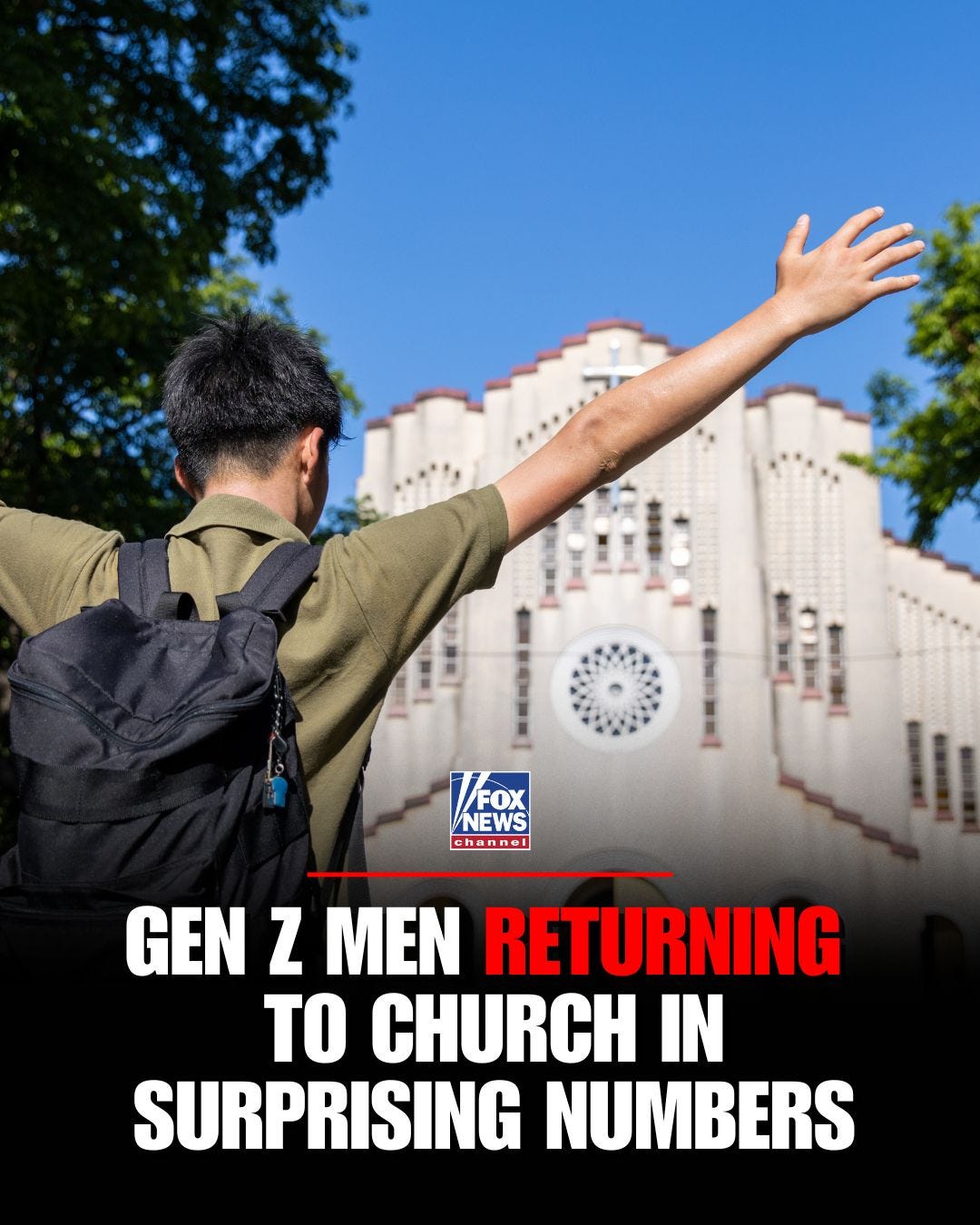
Gen Z’s Religious Landscape
"They're not just staying more committed — some are coming back. The numbers on Gen Z Catholics alone tell you that."
Among Gen Z specifically, the picture is more encouraging than the overall numbers suggest. They’re unsurprisingly the least religious generation overall, but the data shows two things happening at once: those already in church are more committed than their Millennial predecessors were at the same age — the Barna Group found regular churchgoers under 30 now attend nearly twice as often as they did in 2020 — and the share of Gen Z identifying as Christian has actually grown. The Harvard Youth Poll tracked Gen Z Catholics rising from 15% to 21% between 2022 and 2023.
The Catholic Scoreboard
For the first time in modern American history, Gen Z Catholics now outnumber Gen Z Protestants—21 percent to 19 percent, according to the 2023 Cooperative Election Study. That is not a minor shift. It is a reversal of a demographic pattern that held for generations.
And it is not just showing up in one survey. Dioceses in various places have reported increases in adult baptisms and strong enrollment in conversion programs. In France, adult baptisms rose sharply last Easter. In the United Kingdom, young Catholic churchgoers now outnumber young Anglicans. A decade ago, that would have sounded absurd.
Part of what makes this interesting is that the very things critics assumed would make Catholicism unattractive to modern people may be part of what is drawing them in. Its structure. Its continuity. Its firmness. Its refusal to reinvent itself every five minutes. For a generation raised on instability, constant reinvention, and thin moral language, a faith that actually knows what it is can feel less like a burden and more like solid ground.
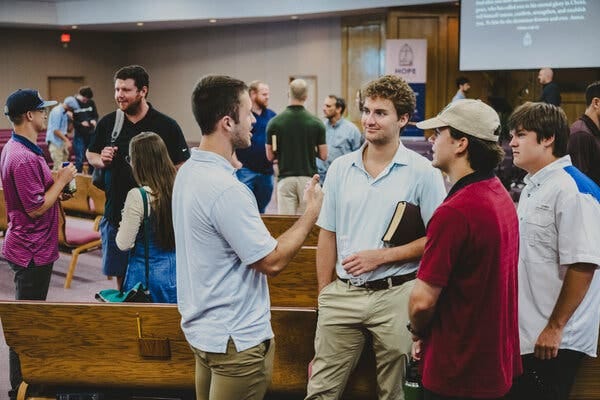
The Protestant picture is more complicated.
While the trend of youth returning to Christianity is also seen in mainline Protestant denominations, their numbers overall continue to shrink. Churches that have struggled to maintain a clear identity have also struggled to hold or attract young people, particularly not on-scale with the Catholic Church. Perhaps that shouldn’t surprise anyone. If a church can’t say plainly what it is, where it stands, and why, and if those Truth claims fall apart at the next denominational church down the road, why would anyone especially a young adult looking for truth, coherence, and substance be drawn to it?
Evangelical and Pentecostal communities, however, present a different picture. Some are growing, especially where there is strong community life, real conviction, and a clear sense of mission. Barna’s data also showed a notable increase in Americans saying they had made a personal commitment to faith, with younger men driving much of that movement. The picture is uneven, but there is clearly some energy there.
Broader Significance of the Matter
Part of this phenomenon is cultural. The mood has shifted in much of the West. In 2024, only 18 percent of Americans thought religion was gaining influence in public life. By early 2025, that number had risen to 31 percent. In an age of collective identity crisis and a liquidation of culture (Culture builds Identity), people are not only looking for Truth, they’re looking for meaning and identity where the secular order has deprived them of all of it.
Then part of it is also generational. As people settle into adult life—work, marriage, children, responsibility—religious practice often rises. That pattern isn’t automatic, but it is natural enough to be notable. Gen Z is only now entering that stage. The next five to ten years will tell us far more than the present moment can.
Now it’s up to the Church to take the hint and respond to what clearly appears to be the beginning of a revival. That means the ecclesial Church, and the Catholic faithful need to step it up, think outside the box, and evangelize by witness, bold, clear voices, and an attitude of unity and charity so that we reflect what the youth are searching for. They don’t want watered down religion. They don’t want disunity and practical civil-war. And they don’t want a Christianity that doesn’t take itself seriously. The time is now to restore Early Church vigor and boldness. This is the era of Saints. You’re watching that story play out now. Better still, we are all called to play a role in it.
Follow me on X | Instagram | TikTok | FB | YouTube
References
Pew Research Center – Decline of Christianity in the U.S. Has Slowed, May Have Leveled Off
https://www.pewresearch.org/religion/2025/02/26/decline-of-christianity-in-the-us-has-slowed-may-have-leveled-off/PRRI – Generation Z Fact Sheet
https://www.prri.org/spotlight/prri-generation-z-fact-sheet/Barna Group – Young Adults Lead Resurgence in Church Attendance
https://www.barna.com/research/young-adults-lead-resurgence-in-church-attendance/Barna Group – Belief in Jesus Rises Among Gen Z
https://www.barna.com/research/belief-in-jesus-rises/Northeastern University – Is Gen Z Returning to Religion?
https://news.northeastern.edu/2025/06/10/gen-z-religion-trend/National Catholic Register (CNA) – Are There More Gen Z Catholics Than Protestants?
https://www.ncregister.com/cna/fact-check-are-there-more-gen-z-catholics-than-protestantsReligion Unplugged – Gen Z and Millennial Men Driving Church Attendance Trend
https://religionunplugged.com/news/2025/10/9/gen-z-and-millennial-men-driving-new-church-attendance-trendBarna Group – “State of the Church 2025” https://www.barna.com/research/state-of-the-church-2025/
Cooperative Election Study 2023