

Costume Christianity
When Christianity becomes a brand accessory for the powerful, everyone notices—except them.
Something has been bothering me lately. Not the usual complaints about politics and religion mixing; that's an old argument, and not always a wrong one. What's bothering me is something more specific: the growing number of people in public life who wear Christianity like a lanyard. It's visible. It signals something. But you get the sense they never think about it after they leave the building.
There’s a difference between wearing a cross and carrying one. One is an accessory. The other is a way of life. And lately, that distinction has been getting harder to miss.
On Easter Sunday, President Trump posted an expletive-laden threat against Iran on Truth Social, warning the country would be “living in Hell” if they didn’t open the Strait of Hormuz, and signing off with “Praise be to Allah.”
Easter Sunday. That same night, he posted an AI-generated image appearing to show himself as Jesus Christ, laying his hand on a man who appeared sick or dying, light emanating from his palm. He later took it down and claimed he thought it was showing him as a doctor. Nobody bought that.
And then Secretary of War Pete Hegseth at a Pentagon prayer service, read what he framed as a prayer inspired by Ezekiel 25:17—except the text was almost entirely lifted from Quentin Tarantino’s Pulp Fiction. Granted, it seemed to have originated with an Air Force team who rescued American troop from Iran and Hegseth was merely incorporating it into the prayer service. But it’s still Christian-flexing without actual Christian identity.
The actual Ezekiel 25:17, for the record, is one sentence long. Everything else in that famous monologue was invented for the movie. Hegseth read it at a worship service. Solemnly. And asked everyone to pray along.
These aren’t minor slip-ups. They’re revealing. When you don’t read the Bible, you don’t know what’s in it. When Easter Sunday is just another morning on Truth Social, the Resurrection isn’t shaping how you move through the world, how you think, how you speak or withhold speech. It just becomes a holiday on the calendar, with Christian connotations.
Now, I’m not here to judge anybody. We’re all works in progress, God knows. I’ve said dumb things. I’ve made bad calls. The Church herself teaches that we meet people where they are, and that’s right. None of us gets to declare who’s in or out with God.
But there’s a difference between being flawed and being performative. A flawed Christian stumbles and knows it. A performative one puts on the costume when the cameras are on.
Franklin Graham called Trump “the most pro-Christian president ever” and defended the Jesus image as “a lot to do about nothing,” insisting there were “no spiritual references — no halo, no crosses, no angels.” Are we really supposed to believe this is Trump as a DOCTOR?
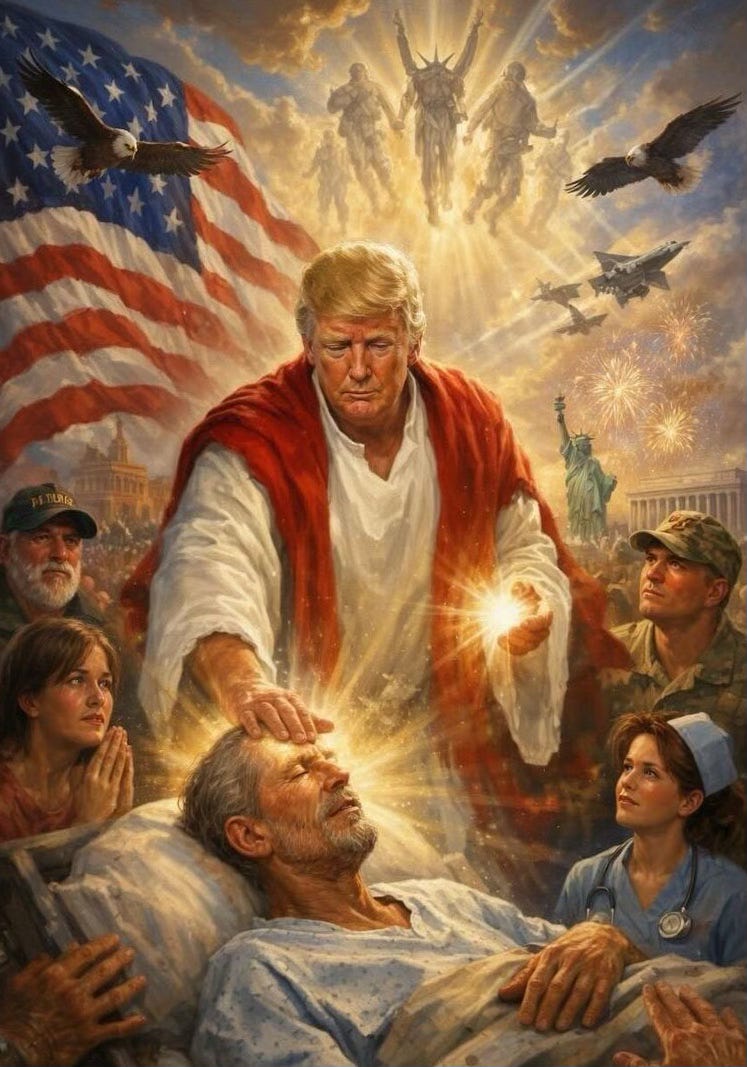
Even if the prompt to the AI wasn’t “Make me look like Jesus” surly somebody (Trump or whoever manages his social posts) had to see this image looked like Jesus, and they posted it anyway.
Hegseth himself said at the service that what happens in worship should “inform the remainder of our day” and “who we are and how we conduct ourselves, no matter what we are doing.” He’s right, and that’s a great message. And that’s precisely the standard by which all of this falls short. Don’t “Christian-it-up” if it’s about the optics and not the substance. I like that the Christian faith has made an appearance in the culture at these upper levels, but if you’re going to bring it there, don’t put on a show, make it real. Have someone else do the prayer service. Post something real about your faith life on Truth Social. Synthetic Christianity has no place anywhere.
We can accept people as they are. We should. But if you’re going to invoke the Lord — at a prayer service, in an Easter post, in an AI image on a Sunday night — you’re making a claim. And claims can be examined. The question isn’t whether someone is a real Christian in their heart. The question is whether the Christianity being performed publicly has any relationship to what Christianity actually is.
If it doesn’t, that insults the Lord. It insults the faithful. And it insults the intelligence of everyone watching.
You don’t have to be a saint to lead. But don’t put on the costume and call it a conversion.